🎹 Music for this post: https://www.youtube.com/watch?v=LcJAWBsLVZ8.
In The Invisible Propeller, I concluded with a quote from Lisa Hermsen (the Caroline Werner Gannett Professor of Humanities at RIT):
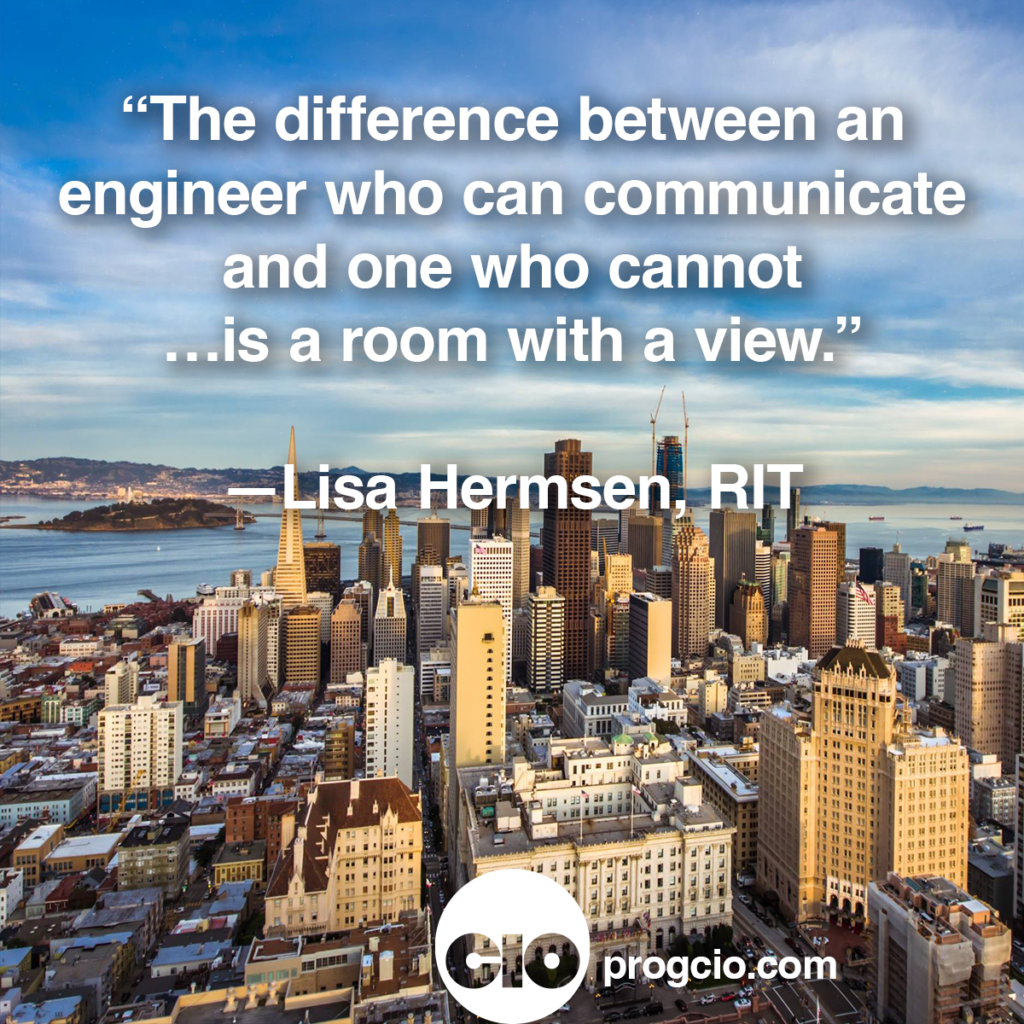
“The difference between an engineer who can communicate and one who cannot…is a room with a view.”
In other words, if your communication skills aren’t top-notch, your career opportunities — and resultant lifestyle — will be limited. It’s my opinion that this should be the first lesson in any aspiring engineer’s education, lest we set students on a miserable journey toward dashed career expectations.

Longtime readers of this blog know that my father taught me this lesson at just the right moment in my life, and I have devoted the second half of my career to paying his lesson — and my good fortune to absorb it — forward, tirelessly.
For those of you who are new to this blog, the core communication skills are embodied in six of The Progressive CIO’s eight foundational values: Vulnerability, Humility, Empathy, Patience, Compassion, and Commitment.
I once had a software engineering student at RIT who told me that he was skeptical about the value of his own major (which is distinguished by a balanced emphasis on human and computing skills.) He said something to the effect of “too many software engineers can get away without knowing anything about computers. Only computer science majors truly understand computers, and I would hire them to program before I would hire a software engineer.”
And there I had it: an otherwise progressive young man within my own field, denigrating the value of what many condescendingly call “soft skills” that are essential to success.
I asked the young man to consider doctors for a minute.
There are MDs who supervise medical research in laboratories for companies. MDs who consult for the government. MDs who work for insurance companies. MDs who perform pathology or radiology. Then, there are the MDs who “lack bedside manner” (many fine surgeons). These doctors are at their best when they are handed an established problem to solve. In software engineering, we might call these people coding monkeys.
But these are not the doctors who elicit problems from patients.
The doctors we tend to value most are those who interact well with us when we don’t feel well, and help us figure out what might be going on. Through keen listening and empathy skills, they are able to turn vague symptoms into accurate diagnoses. These are the doctors most of us seek as a first resort, always ready to lend a listening ear, a thoughtful mind, and a sympathetic eye.
“You,” I shared with my student, “are like one of those doctors.” Computer scientists may be better-trained for the laboratories of our field, away from the patients the software engineers are better-trained to serve, but it’s one thing to understand computers; it is an entirely other thing to understand people.
I’d like to revisit the condescension of soft skills.
What are “hard” skills? Math, science, logic, and other formal methods that bachelors of science work to master. These skills do not come naturally, and are learned through reading, formal exercises, and other pedagogy. Hard skills can be tested objectively.
What scientists refer to as “soft skills” can only be tested subjectively, making them easy for scientists to dismiss. Whenever the term is uttered, the hairs on the back of my neck stand up in the same way that they did when I — as a computer-programming, clarinet-playing, poetry-writing youngster — was called “wuss,” “fool,” “sissy” or many other hurtful things. “Soft skills” is condescending because it is a dismissive epithet, deliberately crafted to distinguish these skills as something “fuzzier” and less legitimate than scientific methods.
Fact is — and I didn’t invent this phrase inasmuch as I arrived at it on my own at some point — the soft skills are indeed the hard skills to find in quantity and quality in the workforce. Most people seem to agree that the Venn diagram of great scientists and great communicators does not have a huge union. (Indicators of the presence of this notion tend to be hidden in comments to articles like this one.) Despite what scientists might like to believe, however, development and testing of subjective skills can be done effectively. Just ask a liberal arts professor.
How would a scientist feel if I were to condescend or dismiss their hard skills by calling them “soft,” given my own capabilities for communication, audience analysis, listening, empathy, vulnerability, trust, and so forth? (I admittedly do this from time to time, just to make a point.) Is it possible for us to move on to a world where we use less judgmental terminology?
We could go with: Objectively-Testable Skills and Subjectively-Testable Skills? OTS and STS.
Let’s posit that engineers who are asked to work with other humans on a regular basis should possess something approaching a 50:50 ratio of OTS and STS. Computer Scientists can be successful with a higher OTS:STS ratio; Software Engineers and IT professionals will be most successful with a higher STS:OTS ratio. I don’t care what the scientists say; that’s a maxim.
If STS and OTS sound novel to you, then I’d ask you to appreciate the fact that I’ve deliberately snowed you. What this is really about is nothing new; it’s simply arts and sciences, in balance with one another.
Great scientists benefit from experience and practice in the arts of life. Scientists don’t serve science; they serve humans. Those who learn this lesson will always have a room with a view.
Isn’t that what we all want?
Discuss this specific post on Twitter or LinkedIn.
![[Logo]](https://theprogressivecio.com/wp-content/uploads/2020/07/ProgCIO-1024x1024.png)